
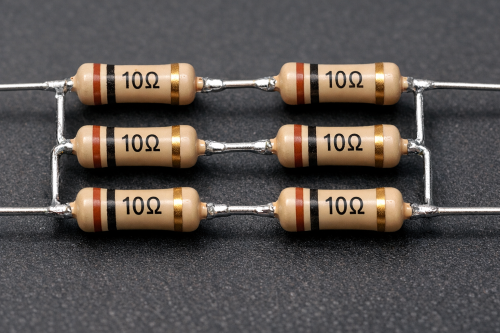
Electrical circuits form the backbone of modern technology, and understanding how components like resistors behave in different configurations is essential for students, engineers, and hobbyists alike. One common and interesting problem in basic electronics involves six resistors, each of 10 ohms, connected in different ways. The total or equivalent resistance of the circuit depends entirely on how these resistors are arranged.
Understanding Resistance
Resistance is the property of a material that opposes the flow of electric current. It is measured in ohms (Ω). When resistors are connected in a circuit, their total resistance changes depending on whether they are arranged in series, parallel, or a mix of both.
Case 1: All Six Resistors in Series
When resistors are connected in series, the current flowing through each resistor is the same. The total resistance is simply the sum of all individual resistances.
R_{eq} = R_1 + R_2 + R_3 + \cdots + R_n
Since each resistor is 10 ohms:
[
R_{eq} = 10 + 10 + 10 + 10 + 10 + 10 = 60 , \Omega
]
Key Insight:
- Total resistance increases in series.
- Equivalent resistance = 60 ohms
Case 2: All Six Resistors in Parallel
In a parallel connection, the voltage across each resistor is the same, but the current divides among the branches.
\frac{1}{R_{eq}} = \frac{1}{R_1} + \frac{1}{R_2} + \cdots + \frac{1}{R_n}
Since all resistors are equal:
[
\frac{1}{R_{eq}} = \frac{1}{10} + \frac{1}{10} + \frac{1}{10} + \frac{1}{10} + \frac{1}{10} + \frac{1}{10} = \frac{6}{10}
]
[
R_{eq} = \frac{10}{6} \approx 1.67 , \Omega
]
Key Insight:
- Total resistance decreases in parallel.
- Equivalent resistance ≈ 1.67 ohms
Case 3: Three in Series, Two Such Groups in Parallel
Let’s divide the six resistors into two groups of three resistors each.
Step 1: Series Combination in Each Group
Each group:
[
R = 10 + 10 + 10 = 30 , \Omega
]
Step 2: Parallel Combination of Two Groups
[
\frac{1}{R_{eq}} = \frac{1}{30} + \frac{1}{30} = \frac{2}{30}
]
[
R_{eq} = 15 , \Omega
]
Key Insight:
- Equivalent resistance = 15 ohms
Case 4: Two in Series, Three Such Groups in Parallel
Now, divide the six resistors into three groups of two resistors each.
Step 1: Series in Each Group
[
R = 10 + 10 = 20 , \Omega
]
Step 2: Parallel of Three Groups
[
\frac{1}{R_{eq}} = \frac{1}{20} + \frac{1}{20} + \frac{1}{20} = \frac{3}{20}
]
[
R_{eq} = \frac{20}{3} \approx 6.67 , \Omega
]
Key Insight:
- Equivalent resistance ≈ 6.67 ohms
Case 5: Complex Mixed Combination
In many real-world problems, resistors are arranged in more complex combinations involving both series and parallel connections.
For example:
- First, combine two resistors in parallel.
- Then connect that combination in series with another resistor.
- Continue step-by-step until all resistors are accounted for.
Approach:
- Simplify the circuit step by step.
- Replace each simplified part with its equivalent resistance.
- Continue until only one equivalent resistance remains.
Practical Applications
Understanding resistor combinations is not just an academic exercise. It has real-world applications in:
- Designing electrical circuits
- Controlling current flow
- Voltage division in electronic devices
- Power distribution systems
- Building DIY electronics projects
For instance, in devices like televisions, smartphones, and computers, engineers carefully design resistor networks to ensure proper functioning.
Key Differences Between Series and Parallel
| Feature | Series Connection | Parallel Connection |
|---|---|---|
| Current | Same in all resistors | Divided among branches |
| Voltage | Divided | Same across each resistor |
| Equivalent Resistance | Increases | Decreases |
| Failure Impact | Circuit breaks | Others still work |
Important Tips for Solving Problems
- Always identify the type of connection first.
- Simplify step by step rather than solving everything at once.
- For equal resistors in parallel, use shortcut:
[
R_{eq} = \frac{R}{n}
]
where n is the number of resistors. - Double-check units and calculations.
Conclusion
The equivalent resistance of six resistors, each of 10 ohms, can vary significantly depending on how they are connected. In series, the resistance becomes as high as 60 ohms, while in parallel, it drops to about 1.67 ohms. Intermediate configurations produce values in between.
Mastering these concepts is essential for anyone studying physics or working in electronics. It builds a strong foundation for understanding more advanced topics like circuit analysis, electrical networks, and electronic design.
By practicing different configurations and applying the formulas correctly, you can confidently solve any resistor network problem.