
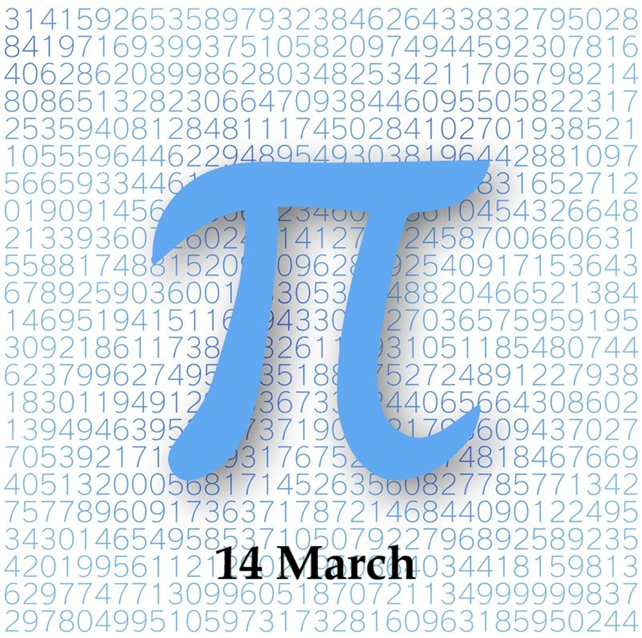
Every year on March 14, mathematics lovers, students, teachers, and science enthusiasts around the world celebrate Pi Day. This special day honors one of the most important numbers in mathematics, Pi (π). The celebration combines education, creativity, and fun, making mathematics exciting for people of all ages.
Pi Day is not just about numbers. It is about appreciating the role of mathematics in science, engineering, technology, and everyday life. From classrooms and universities to tech companies and science organizations, Pi Day is celebrated with puzzles, competitions, and even pie-eating contests.
What is Pi?
Pi (π) is a mathematical constant that represents the ratio of the circumference of a circle to its diameter. No matter how large or small a circle is, this ratio is always the same.
This formula shows how Pi is used to calculate the circumference of a circle.
Pi is an irrational number, meaning its decimal form never ends and never repeats. The value of Pi begins as:
3.14159265358979323846…
For most calculations, people use 3.14 or 22/7 as an approximation.
Because circles appear everywhere—from wheels and planets to pipes and electronics—Pi is used in many scientific calculations.
Why is Pi Day Celebrated on March 14?
The date March 14 (3/14) matches the first three digits of Pi: 3.14. This simple connection made the date perfect for celebrating the famous number.
Pi Day celebrations usually start at 1:59 PM, representing the next digits of Pi: 3.14159.
The celebration began in 1988 at the Exploratorium, a science museum in San Francisco. Physicist Larry Shaw organized the first official Pi Day event there, which included a circular parade and fruit pies.
Since then, Pi Day has become a global celebration.
International Recognition of Pi Day
In 2019, UNESCO officially recognized International Day of Mathematics, which is celebrated every year on March 14. This recognition helped promote mathematics education worldwide.
Interestingly, March 14 is also the birthday of the famous physicist Albert Einstein, making the date even more special for science enthusiasts.
Importance of Pi in Mathematics and Science
Pi plays a crucial role in many areas of mathematics and science. Some of its major applications include:
1. Geometry
Pi is essential for calculating the area and circumference of circles.
This formula is used to determine the area of a circle.
2. Engineering and Construction
Engineers use Pi when designing wheels, pipes, tunnels, gears, and mechanical systems. Circular structures rely heavily on Pi-based calculations.
3. Physics
In physics, Pi appears in formulas related to waves, motion, energy, and quantum mechanics. It helps scientists understand the behavior of the universe.
4. Computer Science
Computers are used to calculate more and more digits of Pi. Scientists and programmers run powerful algorithms to determine trillions of digits of Pi.
5. Space and Astronomy
Pi helps scientists calculate planetary orbits, satellite paths, and space missions. Without Pi, many astronomical calculations would be impossible.
Fun Ways People Celebrate Pi Day
Pi Day is celebrated in creative and entertaining ways across the world. Some popular activities include:
Pie Eating Contests
Since “Pi” sounds like “Pie,” many celebrations include eating or baking pies. Schools and offices organize pie-themed events.
Math Competitions
Students participate in quizzes, puzzle-solving competitions, and problem-solving challenges related to mathematics.
Memorizing Pi Digits
Some enthusiasts try to memorize as many digits of Pi as possible. The world record involves remembering tens of thousands of digits.
Educational Workshops
Teachers and universities organize lectures, workshops, and math demonstrations to explain the importance of Pi.
Coding and Science Activities
Many technology communities celebrate Pi Day by writing programs to calculate Pi or exploring mathematical simulations.
Interesting Facts About Pi
Pi has fascinated mathematicians for thousands of years. Here are some interesting facts:
Ancient civilizations such as Ancient Egypt and Ancient Babylon used early approximations of Pi.
The Greek mathematician Archimedes made one of the earliest accurate calculations of Pi.
The symbol π was first used by the mathematician William Jones in 1706.
Later, the famous mathematician Leonhard Euler helped popularize the symbol π in mathematics.
Modern computers have calculated trillions of digits of Pi.
Despite these calculations, Pi will never end because it is an irrational number.
Pi in Everyday Life
Many people think Pi is only useful in advanced mathematics, but it actually appears in everyday situations. For example:
Designing car tires and wheels
Building circular tanks and water pipes
Calculating the rotation of engines
Creating digital graphics and animations
Developing satellite communication systems
Even technologies like GPS navigation and medical imaging rely on calculations that include Pi.
Pi Day in Schools and Universities
Educational institutions play a major role in celebrating Pi Day. Teachers use the occasion to make mathematics more engaging and interactive.
Students participate in activities such as:
Creating Pi-themed art projects
Reciting digits of Pi
Solving geometry problems
Learning about famous mathematicians
These activities help students see mathematics as fun and creative rather than difficult.
The Future of Pi Exploration
Although Pi has been studied for thousands of years, mathematicians are still discovering new patterns and applications. Advanced computers continue to calculate more digits of Pi, mainly to test computational algorithms and hardware performance.
Researchers also explore Pi’s role in quantum physics, cryptography, and data science. This means Pi will remain an important part of scientific discovery for years to come.
Conclusion
Pi Day is a celebration of mathematics, curiosity, and human discovery. What started as a small event in a science museum has grown into a global celebration enjoyed by students, teachers, scientists, and math lovers everywhere.
By recognizing the importance of Pi, people also appreciate the role mathematics plays in shaping modern technology and scientific progress. Whether through solving puzzles, baking pies, or exploring mathematical ideas, Pi Day offers a fun way to learn and celebrate one of the most fascinating numbers in the world.
Every year on March 14, Pi Day reminds us that even a simple number can open the door to endless knowledge and discovery.